Communities, developers, utilities, project teams and governments making complicated infrastructure decisions.
SELECTED COMMENTS
“Show us the tradeoffs before the site is locked in.”“Let community priorities be evidence, not an afterthought.”“Help utilities explain what is feasible and when.”“Give project teams one fact base instead of five competing spreadsheets.”“Compare another site before assuming the current one is best.”
AI strategy is quickly becoming infrastructure strategy.
Humetriq = Human insight + Metrics + IQPowered by AI. Guided by people.
Building something big? Understand the full picture before choosing where it goes.
Major infrastructure projects affect developers, communities, utilities, workers and governments. Humetriq brings their perspectives and the underlying data together in one place, helping teams explore locations, understand tradeoffs and make better-informed decisions before commitments are made.
Power, water, land, cost, workforce, environmental impact, community priorities and other critical information are often scattered across different sources and stakeholders.
Brings those factors together so people can compare alternatives, explore different priorities and understand the tradeoffs before a decision is made.
AI-powered decision intelligence, in plain English: one shared place to see the important factors, test alternatives and make the tradeoffs visible while accountable people make the decision.
And “where it goes” can be part of the answer.Humetriq can evaluate a proposed site, compare several candidate sites, or help surface which locations deserve consideration in the first place.
ONE DECISIONMany realities
 Best-fit
decision
CommunityPriorities • concerns
benefits • local impacts
benefits • local impacts
PowerAvailability • capacity
grid impacts • reliability
grid impacts • reliability
ConnectivityFiber • latency • redundancy
network cost • providers
network cost • providers
SiteLand • zoning • proximity
constraints • expandability
constraints • expandability
Water + environmentWater • cooling
environmental impact
environmental impact
Risk + resiliencePermitting • policy • social
operational • environmental
operational • environmental
WorkforceSkills • training • supply
local employment
local employment
EconomicsCapital • operating costs
incentives • jobs • tax base
incentives • jobs • tax base
Market + workloadDemand • timing
use cases • growth
use cases • growth
Many realities→Responsible AI→Better-informed decisionsHuman judgment stays in the decision.
Human insight + metrics + AI-powered exploration - with accountable people making the decision.
REAL-WORLD EXAMPLEWhere should a new data center be built?
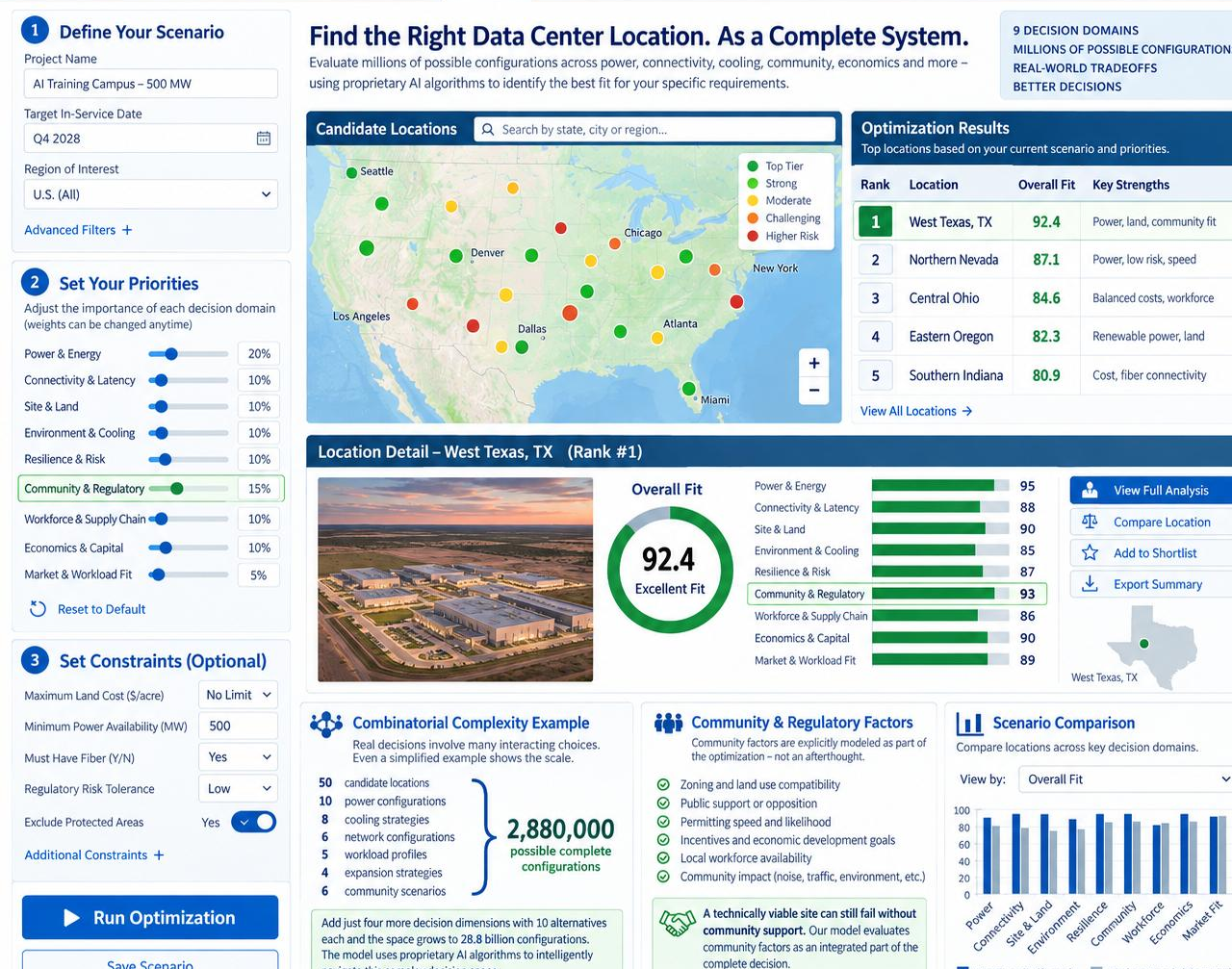
Humetriq can start with a proposed site, compare a known shortlist, or help identify additional locations worth considering. It brings power and water capacity, connectivity, land and zoning, workforce, economics, environmental conditions, developer requirements and community priorities into the same decision - then shows how the leading alternatives change as assumptions and priorities change.
≈1.3 TRILLIONpossible configurations in one illustrative decision scenario.
>41,000 YEARSto review that illustrative space at one configuration per second.
Decision time, not human timeAI-powered decision intelligence helps surface alternatives and visible tradeoffs without exposing protected model mechanics.
A different kind of AI
AI for decisions where the answer is not known in advance.
Humetriq does not start with a single answer it is trying to defend. It explores a structured decision space: sites, infrastructure configurations, constraints, priorities, expert knowledge, community evidence and tradeoffs. The result is not just an answer. It is a set of better-informed choices people can interrogate, including which location should be considered in the first place.
01
Explore, don't just generate
Humetriq is built to compare structured alternatives and combinations, not simply return a fluent response to a prompt.
02
Human evidence is data too
Expert judgment, stakeholder priorities and community input can be considered alongside power, water, network, land, cost, workforce and environmental evidence.
03
The site can be an output
Start with a proposed site, compare known candidates, or ask a broader question: given what we are trying to build, where should it go?
04
People stay accountable
Humetriq helps people understand why alternatives rise or fall as assumptions change. It supports the decision; accountable people still make it.
Early access
Help shape better infrastructure decisions.
Join the Humetriq early-access community and get useful information while the product is being built.
Data-center insightsCurated infrastructure and decision-intelligence updates worth knowing.
Beta invitationsHelp test Humetriq with real decision scenarios and give direct product feedback.
10% launch benefitBeta participants are eligible for 10% off their first year when Humetriq is commercially launched.
Early access does not guarantee beta placement. We will keep communications relevant and you can opt out at any time.
One decision, many perspectives
Infrastructure decisions are combinatorial.
Even a deliberately simplified scenario can create an enormous decision space. Humetriq uses AI-powered decision intelligence to navigate complexity, surface promising alternatives and make tradeoffs easier to understand - without disclosing the protected methods used inside the engine.
EXAMPLE ONLY • DELIBERATELY SIMPLIFIED
2.88 million complete configurations - before the real-world decision becomes more complex.
This teaching example shows how quickly combinations multiply. Add only four more dimensions with ten alternatives each and the space becomes 28.8 BILLION. A larger illustrative scenario can exceed 1.3 TRILLION possibilities - more than 41,000 YEARS of review at one combination per second.
These numbers illustrate combinatorial scale. They are not a disclosure of Humetriq's internal architecture, factor dictionary, weighting logic or search method.
Illustrative decision dimensionAlternatives
Candidate locations50
Power configurations10
Cooling strategies8
Network configurations6
Workload profiles5
Expansion strategies4
Community scenarios6
Possible complete configurations2,880,000
01
Combine the evidence
Bring together company data, public and commercial sources, technical expertise, utility inputs and community evidence - with provenance.
02
Explore compromise
Adjust priorities, constraints and acceptable tradeoffs, then compare alternatives without publishing proprietary weighting or optimization mechanics.
03
Compare viable options
Review leading configurations and alternatives, including whether a different site, infrastructure choice or neighboring community creates a better overall fit.
Friendly by design
Useful to the people who build, operate, approve, manage or live with the decision.
Humetriq helps each constituency contribute what it knows, understand what others need, and test whether a better solution exists.
Make local priorities part of the model.
Use surveys, planning records, resident concerns and community-benefit priorities as evidence - not as a late-stage obstacle.
Reflect real infrastructure constraints.
Represent capacity, timing, reliability, expansion, water and interconnection realities.
Find feasible projects faster.
Compare sites and configurations before committing capital, and test whether mitigation or a different location improves total fit.
Give project managers a common decision workspace.
Coordinate planners, engineers, contractors, utilities, finance, community stakeholders and executives around shared assumptions.
Create a common fact base.
Test proposals, alternatives, mitigation and neighboring sites with municipalities and economic-development teams.
Capture the people side of growth.
Bring skills availability, commuting patterns, training capacity, wage pressure and local workforce priorities into the picture.
For communities
Communities are part of the decision, not a constraint to work around.
A development may be right for a community, wrong for it, or capable of becoming better through a different site, benefit package or compromise. Humetriq is designed to help make that visible.
✓
Support a proposal when evidence and community priorities align.
↔
Improve a proposal by identifying compromises that raise overall fit.
?
Challenge assumptions when the modeled tradeoffs do not support the current plan.
→
Compare alternatives, including another site or nearby community.
Resource Center
Tools to help people participate in better infrastructure decisions.
Download a community survey, use the Excel contact template, import contacts, invite neighbors and colleagues, or contact Humetriq for help. Everything is collected in one obvious place.
Sample Community Infrastructure Survey
A neutral questionnaire covering priorities, concerns, benefits, location tradeoffs, mitigation ideas and information needs.
Download survey (.docx)Outreach + Email Merge Starter Kit
Create a recipient list in Excel with columns such as FirstName, Email, Organization and Role. Keep only the fields needed for outreach.
Download toolkit (.docx)Download example Excel recipient list (.xlsx)Microsoft: send bulk email with Word mail merge ↗More stakeholder surveys
Developers: requirements, schedule, capital, workload and site criteria.
Utilities: capacity, upgrade timing, reliability, water and constraints.
Workers: skills, wages, commuting and training capacity.
Planners: zoning, infrastructure, public priorities and alternatives.
How it works
From many realities to a decision you can interrogate.
1
Collect
Bring together developer, utility, public/commercial, community and expert evidence.
2
Set priorities
Define what matters, acceptable tradeoffs, hard constraints and scenario assumptions.
3
Explore
Use Humetriq's protected decision technology to navigate alternatives.
4
Compare
Review leading configurations and alternatives rather than a single opaque score.
5
Explain
Make tradeoffs visible while accountable people make the decision.
Join the conversation. Be part of the solution.Better infrastructure decisions start when the people affected by them can contribute evidence, priorities and ideas early.
Participate
Start small. Tell us what you are working on.
Choose the path that best fits you, share only enough to start the conversation, and Humetriq will follow up directly.
Early-access forms are for introductory messages only and are delivered through a third-party form service. Do not submit confidential, regulated or personally identifying datasets through these forms.
Questions
Designed to support decisions, not replace people.
Is Humetriq pro-development or anti-development?
Neither. Humetriq is designed to expose evidence, priorities, constraints and tradeoffs so stakeholders can evaluate whether a development fits, can be improved, should move, or should be reconsidered.
Why include community surveys?
Because community knowledge can materially change location, mitigation, benefits and feasibility. Structured surveys help turn that knowledge into evidence that can be considered alongside technical and economic inputs.
Will participants receive data back?
Humetriq intends to explore sanitized, aggregated benchmark findings as participation grows. Any such program will require appropriate consent, governance and de-identification before information is shared.
Does Humetriq replace accountable decision-makers?
No. Humetriq is decision support. It helps people explore a large decision space, compare alternatives and understand tradeoffs while accountable people make the decision.